Weather Alert in California
Heat Advisory issued March 14 at 12:56PM PDT until March 20 at 8:00PM PDT by NWS San Francisco CA
AREAS AFFECTED: San Francisco; Marin Coastal Range; Sonoma Coastal Range; North Bay Interior Mountains; Coastal North Bay Including Point Reyes National Seashore; North Bay Interior Valleys; San Francisco Bay Shoreline; San Francisco Peninsula Coast; East Bay Interior Valleys; Santa Cruz Mountains; Santa Clara Valley Including San Jose; Eastern Santa Clara Hills; East Bay Hills; Southern Salinas Valley/Arroyo Seco and Lake San Antonio; Santa Lucia Mountains and Los Padres National Forest; Mountains Of San Benito County And Interior Monterey County Including Pinnacles National Park; Northern Salinas Valley/Hollister Valley and Carmel Valley; Northern Monterey Bay; Southern Monterey Bay and Big Sur Coast
DESCRIPTION: * WHAT...High temperatures in the low to mid 90s across the interior and 80s along the coastline * WHERE...The Bay Area and Central Coast * WHEN...From 10 AM Monday to 8 PM PDT Friday. * IMPACTS...This level of heat affects most individuals sensitive to heat, especially those without effective cooling and/or adequate hydration. Impacts possible in some health systems and in heat-sensitive industries. Hot conditions can cause heat illnesses. * ADDITIONAL DETAILS...Much above normal temperatures in the upper 80s to mid 90s are expected next week across the Bay Area and Central Coast. Portions of the interior Central Coast may reach the upper 90s starting mid to late week. Overnight lows in the upper 50s to low 60s will offer some relief to the lower elevations but will offer minimal relief within the higher elevations. Conditions will be much above normal along the coast next week but coastal residents may experience more relief overnight than those across the interior. The risk of heat related illnesses will increase with each additional day of heating from this event.
INSTRUCTION: Hydration is a critical piece to surviving the heat. Drink water, and if possible, take water to those who are vulnerable. Take extra precautions when outside. Wear lightweight and loose fitting clothing. Try to limit strenuous activities to the early morning or evening. Take action when you experience symptoms of heat exhaustion and/or heat stroke. Beat the heat and check the backseat! Do not leave young children or pets in unattended vehicles.Car interiors will reach lethal temperatures in a matter of minutes.
Want more detail? Get the Complete 7 Day and Night Detailed Forecast!
Current U.S. National Radar--Current
The Current National Weather Radar is shown below with a UTC Time (subtract 5 hours from UTC to get Eastern Time).

National Weather Forecast--Current
The Current National Weather Forecast and National Weather Map are shown below.

National Weather Forecast for Tomorrow
Tomorrow National Weather Forecast and Tomorrow National Weather Map are show below.

North America Water Vapor (Moisture)
This map shows recent moisture content over North America. Bright and colored areas show high moisture (ie, clouds); brown indicates very little moisture present; black indicates no moisture.

Weather Topic: What are Cirrocumulus Clouds?
Home - Education - Cloud Types - Cirrocumulus Clouds
 Next Topic: Cirrostratus Clouds
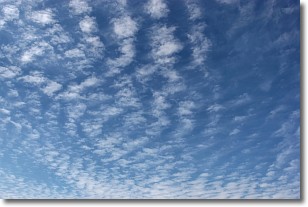
Cirrocumulus clouds form at high altitudes (usually around 5 km)
and have distinguishing characteristics displayed in a fine layer of
small cloud patches. These small cloud patches are sometimes referred to as
"cloudlets" in relation to the whole cloud formation.
Cirrocumulus clouds are formed from ice crystals and water droplets. Often, the
water droplets in the cloud freeze into ice crystals and the cloud becomes a
cirrostratus cloud. Because of this common occurrence, cirrocumulus cloud
formations generally pass rapidly.
Next Topic: Cirrostratus Clouds
Weather Topic: What are Cirrus Clouds?
Home - Education - Cloud Types - Cirrus Clouds
 Next Topic: Condensation
Cirrus clouds are high-level clouds that occur above 20,000 feet
and are composed mainly of ice crystals.
They are thin and wispy in appearance.
What do they indicate?
They are often the first sign of an approaching storm.
Next Topic: Condensation
Current conditions powered by WeatherAPI.com