Weather Alert in Montana
Avalanche Warning issued March 14 at 7:49AM MDT by NWS Missoula MT
AREAS AFFECTED: Kootenai/Cabinet Region
DESCRIPTION: AVWMSO The following message is transmitted at the request of Idaho Panhandle Avalanche Center Sandpoint ID. ...AVALANCHE WARNING ISSUED BY THE IDAHO PANHANDLE AVALANCHE CENTER... 07:00 PDT Sat Mar 14 2026 The Idaho Panhandle Avalanche Center in Sandpoint has issued a BACKCOUNTRY AVALANCHE WARNING for the following areas: NWS Missoula MT - MTZ001 (MTZ001) NWS Spokane WA - ID 079 (Shoshone County) * WHAT...An Avalanche Warning is in effect from Saturday 7 AM PST to Sunday 7 AM PST. Very dangerous avalanche conditions developed Wednesday night from heavy snowfall and strong to extreme winds, and these hazardous conditions are lasting through Sunday due to continued heavy snowfall in specific locations and sustained winds strong enough to transport the abundant new snow. A person's weight or a rider on a machine can very easily trigger avalanches large enough to bury or kill them, and some slides will release naturally. * WHERE...The Bitterroot Mountains - Silver Valley and the East Cabinet Mountains above 4,000 feet. * WHEN...In effect from Sat 07:00 PDT to Sun 07:00 PDT. * IMPACTS...An atmospheric river and violent jet stream joined forces to deliver heavy snowfall and strong to extreme winds to the Inland Northwest. Wind speeds peaked on Wednesday night and have subsided considerably since then, however an uptick is expected on Saturday with gusts reaching 40 to 50 mph possible. The sustained moderate to heavy snowfall is being measured in multiple feet at higher elevations and winds are forecasted to remain strong enough to cause significant transport and redistribution of snow. The recent snowfall has formed dangerous slabs of snow and will likely cause a widespread cycle of natural avalanches large enough to bury, injure, or kill a person. * PRECAUTIONARY / PREPAREDNESS ACTIONS...Very dangerous avalanche conditions exist in the mountains and widespread areas of unstable snow are expected. The largest slides may run long distances and can run into mature forests, valley floors, or flat terrain. Travel in or near avalanche terrain is not recommended and should be avoided during this period of significant instability. Consult http://www.idahopanhandleavalanche.org/ or www.avalanche.org for more detailed information. Similar avalanche danger may exist at locations outside the coverage area of this or any avalanche center.
INSTRUCTION: N/A
Want more detail? Get the Complete 7 Day and Night Detailed Forecast!
Current U.S. National Radar--Current
The Current National Weather Radar is shown below with a UTC Time (subtract 5 hours from UTC to get Eastern Time).

National Weather Forecast--Current
The Current National Weather Forecast and National Weather Map are shown below.

National Weather Forecast for Tomorrow
Tomorrow National Weather Forecast and Tomorrow National Weather Map are show below.

North America Water Vapor (Moisture)
This map shows recent moisture content over North America. Bright and colored areas show high moisture (ie, clouds); brown indicates very little moisture present; black indicates no moisture.

Weather Topic: What are Cirrocumulus Clouds?
Home - Education - Cloud Types - Cirrocumulus Clouds
 Next Topic: Cirrostratus Clouds
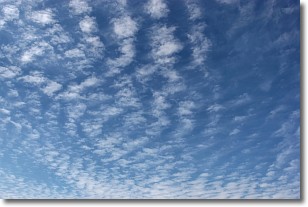
Cirrocumulus clouds form at high altitudes (usually around 5 km)
and have distinguishing characteristics displayed in a fine layer of
small cloud patches. These small cloud patches are sometimes referred to as
"cloudlets" in relation to the whole cloud formation.
Cirrocumulus clouds are formed from ice crystals and water droplets. Often, the
water droplets in the cloud freeze into ice crystals and the cloud becomes a
cirrostratus cloud. Because of this common occurrence, cirrocumulus cloud
formations generally pass rapidly.
Next Topic: Cirrostratus Clouds
Weather Topic: What are Cirrus Clouds?
Home - Education - Cloud Types - Cirrus Clouds
 Next Topic: Condensation
Cirrus clouds are high-level clouds that occur above 20,000 feet
and are composed mainly of ice crystals.
They are thin and wispy in appearance.
What do they indicate?
They are often the first sign of an approaching storm.
Next Topic: Condensation
Current conditions powered by WeatherAPI.com