Weather Alerts for California
1. Air Quality Alert for: Imperial County Southwest; Chuckwalla Mountains; Imperial County Southeast; Imperial County West; Imperial Valley; Palo Verde Valley
2. Freeze Warning for: Del Norte Interior; Northern Humboldt Interior; Southern Humboldt Interior; Northern Trinity; Southern Trinity; Northwestern Mendocino Interior; Northeastern Mendocino Interior; Northern Lake County; Southern Lake County
3. Freeze Warning for: Del Norte Interior; Northern Humboldt Interior; Southern Humboldt Interior; Northern Trinity; Southern Trinity; Northwestern Mendocino Interior; Northeastern Mendocino Interior; Northern Lake County; Southern Lake County
4. Freeze Warning for: Lassen-Eastern Plumas-Eastern Sierra Counties
5. Freeze Warning for: Southeastern Mendocino Interior
6. Freeze Warning for: Surprise Valley California; Northern Washoe County
7. Freeze Warning for: Western Siskiyou County; Eastern Curry County and Josephine County
8. Frost Advisory for: Coastal Del Norte; Northern Humboldt Coast; Southwestern Humboldt; Mendocino Coast
9. Frost Advisory for: Coastal Del Norte; Northern Humboldt Coast; Southwestern Humboldt; Mendocino Coast
10. Frost Advisory for: Southwestern Mendocino Interior
11. Frost Advisory for: Southwestern Mendocino Interior
12. Frost Advisory for: Western Siskiyou County; Eastern Curry County and Josephine County
13. Wind Advisory for: Apple and Lucerne Valleys
14. Wind Advisory for: Indian Wells Valley; Mojave Desert
15. Wind Advisory for: Interstate 5 Corridor; Western Antelope Valley Foothills
16. Wind Advisory for: Mojave Desert Slopes
17. Wind Advisory for: Northern Sacramento Valley; Central Sacramento Valley; Southern Sacramento Valley; Carquinez Strait and Delta
18. Wind Advisory for: San Luis Obispo County Beaches; Santa Barbara County Central Coast Beaches
19. Wind Advisory for: Santa Barbara County Southwestern Coast; Santa Ynez Mountains Western Range; Santa Ynez Mountains Eastern Range
20. Wind Advisory for: Santa Lucia Mountains
Want more detail? Get the Complete 7 Day and Night Detailed Forecast!
Current U.S. National Radar--Current
The Current National Weather Radar is shown below with a UTC Time (subtract 5 hours from UTC to get Eastern Time).

National Weather Forecast--Current
The Current National Weather Forecast and National Weather Map are shown below.

National Weather Forecast for Tomorrow
Tomorrow National Weather Forecast and Tomorrow National Weather Map are show below.

North America Water Vapor (Moisture)
This map shows recent moisture content over North America. Bright and colored areas show high moisture (ie, clouds); brown indicates very little moisture present; black indicates no moisture.

Weather Topic: What is Sleet?
Home - Education - Precipitation - Sleet
 Next Topic: Snow
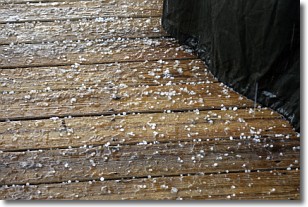
Sleet is a form of precipitation in which small ice pellets are the primary
components. These ice pellets are smaller and more translucent than hailstones,
and harder than graupel. Sleet is caused by specific atmospheric conditions and
therefore typically doesn't last for extended periods of time.
The condition which leads to sleet formation requires a warmer body of air to be
wedged in between two sub-freezing bodies of air. When snow falls through a warmer
layer of air it melts, and as it falls through the next sub-freezing body of air
it freezes again, forming ice pellets known as sleet. In some cases, water
droplets don't have time to freeze before reaching the surface and the result is
freezing rain.
Next Topic: Snow
Weather Topic: What are Stratocumulus Clouds?
Home - Education - Cloud Types - Stratocumulus Clouds
 Next Topic: Stratus Clouds
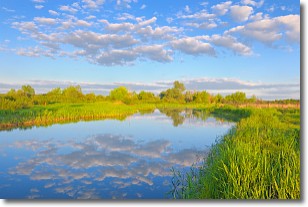
Stratocumulus clouds are similar to altocumulus clouds in their
fluffy appearance, but have a slightly darker shade due to their additional mass.
A good way to distinguish the two cloud types is to hold your hand out and measure
the size of an individual cloud; if it is the size of your thumb it is generally
an altocumulus cloud, if it is the size of your hand it is generally a
stratocumulus cloud.
It is uncommon for stratocumulus clouds to produce precipitation, but if they do
it is usually a light rain or snow.
Next Topic: Stratus Clouds
Current conditions powered by WeatherAPI.com